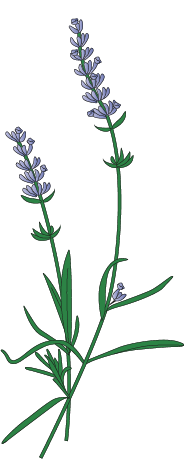
The lavandin

At the time when the cutters were going to pick the wild lavelands, they had already noticed more developed plants than the others they called "Great Lavender", "big lavender" or "lavender lavender":
They were lavendins, from the spontaneous hybridization of true lavender and CSPA.
This hybridization is due to foray insects, mainly bees that, in vote of flower in bloom, transport the pollen from one species to another.
This phenomenon could be checked in 1927 in the laboratories of GRASSE CHIRIS. The artificial pollination of ASPP by lavender pollen has allowed 6 seeds, their seedlings gave two individuals identified as "lavetins".
In nature, there are many different lavendins, closer to the true lavender, sometimes aspic.
The intermediate aspects are all possible, which often makes the morphological identification difficult.
It should be noted that it is in the 1925s that will be differentiated the lavender quality of the lavender, which will create a certain float for several years on these two qualities.
Technical sheet